What Are Fine Ceramics? Types and Applications
-
2025-12-29 Industry News






This guide explains what fine ceramics are, how their microstructure drives performance, common material types, manufacturing processes, and where they’re used—from semiconductors and electronics to life science, automotive, and energy.
Introduce
Fine ceramics, also known as advanced ceramics or functional ceramics, are high-performance ceramic materials that exhibit exceptional properties. They are produced from high-purity inorganic, non-metallic powders through precision forming and high-temperature sintering.
Unlike conventional ceramics, which have relatively coarse and porous microstructures, fine ceramics exhibit excellent mechanical strength, thermal stability, electrical properties, and chemical stability. As a result, they are widely used in high-tech fields such as semiconductors, electronics, life sciences, and energy.
Microstructure of Fine Ceramics and the Mechanisms Behind Their Performance
The performance of fine ceramics is primarily determined by their microstructure and chemical composition. The powders used are fine particles with uniform particle size, typically with a purity of 99.9% or higher. This minimizes the negative impact of impurities and enables high densification and reliability.
Grain size and interfacial structure
Grain size can be controlled from the nanometer to the micron range. By precisely tailoring particle size and grain-boundary structures, crack propagation can be suppressed, and toughness can be improved. In particular, controlling atomic arrangements and stress fields at grain boundaries is crucial for achieving both high strength and high toughness.
Defect control
Defects such as pores and inclusions generated during manufacturing can significantly degrade performance. By combining advanced sintering techniques with powder surface treatments, defect formation can be minimized, ensuring stable mechanical strength and electrical properties.
Multiphase composite structures
Some fine ceramics employ composite structures—combinations of ceramic and ceramic, or ceramic and metal. By optimizing interfaces, synergistic performance can be achieved. For example, zirconia-based composite ceramics can improve fracture toughness through phase transformation.
Doping and functional tuning
By adding rare-earth elements or metal oxides, properties such as electrical conductivity, thermal expansion coefficient, and magnetism can be adjusted. This enables the development of materials with specific functions, including high-thermal-conductivity ceramics, piezoelectric ceramics, and magnetic ceramics.
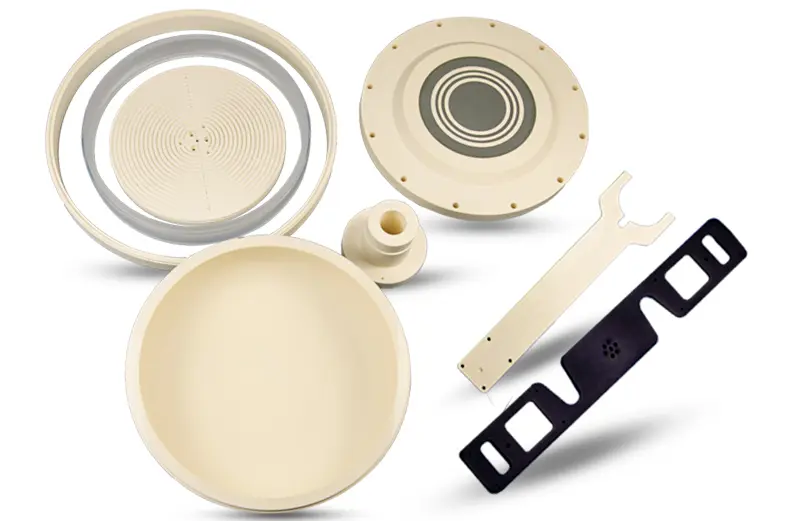
Manufacturing Process of Fine Ceramics
Powder preparation and modification
• High-quality ceramic powders with uniform dispersion are produced using wet ball milling or spray-drying methods.
• Nano-powders promote densification during sintering and improve material performance.
• Surface modification of powders improves dispersibility and formability.
Forming technologies
• Dry pressing and cold isostatic pressing (CIP): suitable for simple-shaped parts and ensures high density under uniform pressure.
• Injection molding: suitable for mass production of complex and fine-structured parts.
• Advanced additive manufacturing (3D printing): enables complex structural designs and customized specifications.
Sintering
• Conventional high-temperature sintering (1400–1800°C): forms strong bonding between particles.
• Hot isostatic pressing (HIP): removes residual pores under high temperature and pressure, improving mechanical strength.
• Atmosphere-controlled sintering: prevents oxidation/reduction and preserves functional properties.
Post-processing
• High-precision machining (surface grinding, wire cutting, etc.) to achieve dimensional accuracy.
• Surface polishing and coating to improve surface smoothness and wear resistance.
Key Performance Indicators of Fine Ceramics
| Performance Category | Parameter | Application Value |
| Mechanical Properties | Fracture Toughness | High resistance to crack propagation; suitable for structural parts requiring high reliability. |
| Vickers Hardness | High surface hardness; performs well in wear-resistant applications. | |
| Elastic Modulus (Young’s Modulus) | High rigidity helps suppress deformation and maintain structural stability. | |
| Thermal Properties | Heat Resistance | Maintains performance under high temperatures and meets high-temperature application demands. |
| Coefficient of Thermal Expansion | It can be tailored for thermal matching to reduce expansion mismatch with metals. | |
| Thermal Conductivity | Selectable across a wide range, enabling material design based on heat dissipation requirements. | |
| Electrical Properties | Relative Permittivity (Dielectric Constant) | Suitable dielectric behavior for high-frequency electronic components. |
| Dielectric Breakdown Strength | Excellent insulation performance; reliable operation in high-voltage environments. | |
| Piezoelectric Properties | Strong electromechanical conversion; applicable to sensors and actuators. | |
| Chemical & Biological Properties | Chemical Stability | Resistant to acids/alkalis and corrosive environments, enabling a long service life under harsh conditions. |
| Biocompatibility | Some materials are certified for biocompatibility and can be used in medical and life-science applications. |
Types of Fine Ceramics
| Material | Chemical Formula | Key Features |
| Alumina | Al₂O₃ | High hardness, wear resistance, and excellent insulation |
| Zirconia | ZrO₂ | High toughness, corrosion resistance, and low thermal expansion |
| Silicon Nitride | Si₃N₄ | High strength, thermal shock resistance, wear resistance, and chemical corrosion resistance |
| Silicon Carbide | SiC | High thermal conductivity, wear resistance, and high-temperature resistance |
| Aluminum Nitride | AlN | High thermal conductivity, excellent insulation, thermal stability |
| Yttria | Y₂O₃ | High melting point, thermal shock resistance, infrared transparency |
| Boron Oxide | B₂O₃ | Low melting point, chemical stability, fluxing behavior |
In addition to classification by composition, fine ceramics can also be categorized by function. Typical functional categories include structural ceramics, electronic ceramics, bioceramics, optical ceramics, and piezoelectric ceramics. Each functional type has unique characteristics in performance design and application fields.
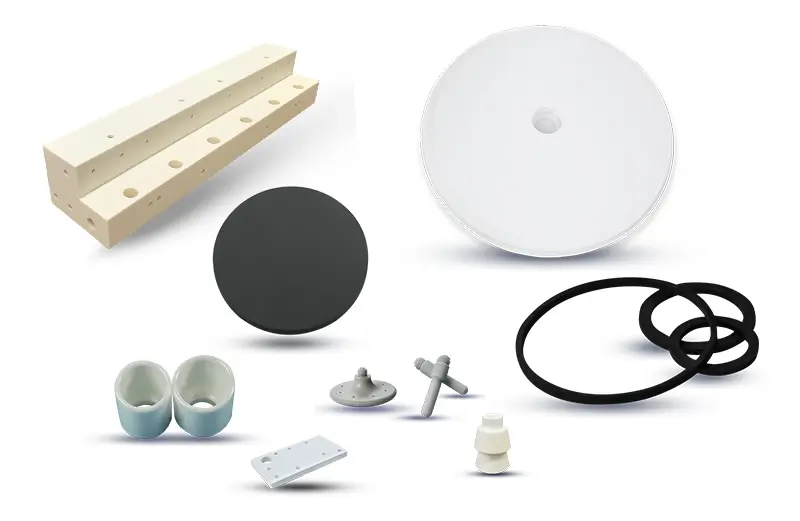
Typical Applications of Fine Ceramics
How to Choose the Right Fine Ceramics
When selecting fine ceramics, the following key factors should be considered comprehensively:
Conclusion
Fine ceramics play an important role as high-performance materials. Leveraging their outstanding mechanical, electrical, thermal, and chemical properties, they are widely used in many high-tech fields such as semiconductors, electronic information, life sciences, energy, and environmental protection. Advances in manufacturing technologies and the development of new materials continue to support further progress in these industries strongly.
For detailed industry knowledge and quotation inquiries related to fine ceramics materials, please feel free to contact JFM. As a comprehensive service provider supporting advanced ceramics R&D through manufacturing, our experienced team delivers optimal solutions tailored to your needs and fully supports the success of your project.