Aluminum Nitride Ceramic Disc: Properties and Applications
-
2026-10-30 Industry News






Explore aluminum nitride ceramic discs, including their thermal conductivity, electrical insulation, key properties, and applications in semiconductor equipment and thermal management.
Introduction
In semiconductor manufacturing and precision electronic equipment, a material’s thermal conductivity, electrical insulation properties, and dimensional stability influence the structural design and operational performance of the equipment. As requirements for thermal management and precision ceramic components continue to become more sophisticated, aluminum nitride ceramics have gradually emerged as a preferred material choice for these applications.
Aluminum nitride ceramic discs combine high thermal conductivity with excellent electrical insulation properties, making them suitable for component designs with specific requirements for heat transfer, electrical isolation, and structural precision. However, actual performance in practical applications also depends on material quality, part geometry, machining precision, and operating conditions. Understanding the material properties, manufacturing processes, and applicable scenarios of aluminum nitride ceramic discs helps engineers evaluate materials and select appropriate components.
What Is an Aluminum Nitride Ceramic Disc?
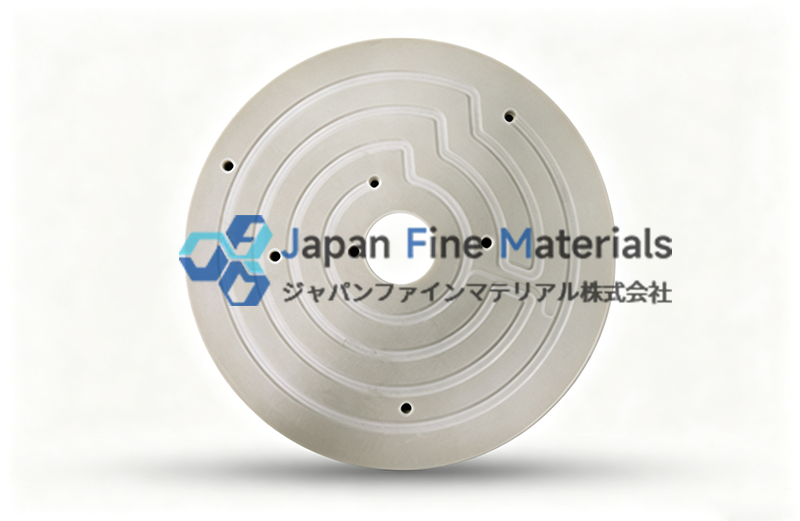
An aluminum nitride ceramic disc is a disc-shaped ceramic component primarily made of aluminum nitride (AlN). Aluminum nitride is an advanced engineering ceramic material characterized by high thermal conductivity and excellent electrical insulation, making it commonly used in applications that require both heat conduction and electrical isolation.
Compared to common insulating ceramics such as alumina, aluminum nitride ceramics are characterized by higher thermal conductivity while maintaining good electrical insulation properties. These material characteristics make them suitable for certain semiconductor devices, precision electronic components, and thermal management structures.
The specific structure of an aluminum nitride ceramic disc can be customized according to equipment design, including diameter, thickness, surface finish, hole placement, and dimensional tolerances. Different designs affect the part’s mounting method, stress conditions, and heat transfer pathways; therefore, selection must be evaluated in conjunction with actual application conditions.
Key Characteristics of Aluminum Nitride Ceramic Discs
High Thermal Conductivity
Aluminum nitride ceramics possess high thermal conductivity; common materials can reach approximately 140–200 W/(m·K), with specific values depending on the material formulation, purity, microstructure, and manufacturing process.
In thermal management applications, a material’s thermal conductivity affects the efficiency of heat transfer within components. For example, when ceramic discs are used in structures that require heat transfer or dissipation, aluminum nitride helps optimize heat transfer pathways.
It is important to note that a component’s actual heat dissipation performance is not determined solely by the material’s thermal conductivity. Factors such as component thickness, contact interfaces, heat source distribution, and mounting methods also affect the overall thermal resistance.
Good Electrical Insulation Properties
Aluminum nitride ceramics possess excellent electrical insulation properties and can be used in structural designs that require both thermal conductivity and electrical isolation.
For semiconductor equipment and precision electronic components, heat transfer and electrical isolation may need to be considered simultaneously. Aluminum nitride ceramics can meet both of these requirements at the material level, making them suitable candidate materials for related insulating or thermal management components.
For specific applications, insulation performance must still be evaluated in conjunction with operating voltage, material thickness, surface condition, and the operating environment.
Thermal Expansion Characteristics
Aluminum nitride ceramics have a relatively low coefficient of thermal expansion, which is similar to that of some semiconductor materials. This characteristic is valuable in structures involving temperature changes, precision assembly, or combinations of multiple materials.
During the equipment design phase, engineers typically need to simultaneously consider the differences in thermal expansion between ceramic components and metals, semiconductor materials, or other structural components. If different materials undergo inconsistent dimensional changes during temperature variations, thermal stress may arise at the connection points, thereby affecting structural reliability.
Therefore, when selecting an aluminum nitride ceramic disc, in addition to considering the material’s coefficient of thermal expansion, one should also analyze the operating temperature range, assembly method, and structural dimensions.
Heat Resistance and Chemical Stability
Aluminum nitride ceramics possess good heat resistance and can be used in certain industrial and electronic equipment structures that must withstand high temperatures. However, their applicable temperature range depends on atmospheric conditions, surface finish, mechanical loads, and specific material grades.
In oxidizing environments, aluminum nitride may undergo surface oxidation; in certain humid environments or under specific chemical conditions, its surface may also be affected. Therefore, the suitability of the material for a given operating condition cannot be determined solely based on its heat resistance; it must be evaluated in conjunction with the actual environment.
For ceramic components in semiconductor equipment, factors such as temperature fluctuations, gas environments, cleanliness requirements, and process media may all affect the material’s suitability.
Main Applications of Aluminum Nitride Ceramic Discs
The applications of aluminum nitride ceramic discs are closely related to their thermal conductivity, electrical insulation, and structural design characteristics. In practical use, their suitability must be determined based on equipment functionality, component geometry, and operating conditions.
Semiconductor Manufacturing Equipment
Semiconductor manufacturing involves multiple stages, including temperature control, wafer processing, and precision equipment structures; some equipment components must balance thermal conductivity, electrical insulation, and dimensional accuracy.
Aluminum nitride ceramics can be used for equipment components that meet the corresponding design requirements. For example, in structures requiring heat transfer or electrical isolation, they can be included in the scope of material evaluation. Whether they can specifically be used for wafer carriers, heating components, or other parts of the equipment must be determined by considering the component’s function, structural design, and the equipment manufacturer’s technical requirements; their application cannot be determined solely based on the material’s name.
Precision Electronic Components
In certain precision electronic devices, localized heat buildup may affect component operation and temperature distribution. The thermal conductivity and electrical insulation properties of aluminum nitride ceramics make them suitable for certain structures that require a balance of both characteristics.
When a ceramic disc serves as a heat-conducting component or part of an insulating structure, its thickness, surface flatness, and contact interfaces can affect overall thermal management performance. Designers typically need to conduct a comprehensive evaluation of the material and component structure, taking into account the component’s power rating, installation space, and heat dissipation paths.
Thermal Management Structures
Thermal management involves not only the thermal conductivity of the material itself but also the location of the heat source, contact area, connection methods, and external heat dissipation conditions.
Aluminum nitride ceramic discs can be used in certain structural designs that require heat transfer. Compared to metallic materials, aluminum nitride ceramics also possess electrical insulation properties, making them valuable for certain thermal management scenarios that require electrical isolation.
However, ceramics are not suitable for all thermal management structures. If an application involves significant mechanical shock, complex connection loads, or special chemical environments, it is also necessary to evaluate the material’s mechanical properties, structural stress, and environmental adaptability.
Manufacturing and Precision Machining of Aluminum Nitride Ceramic Discs
The performance of aluminum nitride ceramic discs depends not only on the material itself but is also influenced by forming, sintering, and subsequent machining processes. For parts with specific requirements regarding dimensions, flatness, or surface quality, each manufacturing stage must be controlled in conjunction with the product design.
Raw Material Preparation and Molding
The manufacturing process typically begins with the preparation of aluminum nitride powder and related formulations. Powder characteristics, additive composition, and mixing uniformity affect subsequent sintering behavior and the material’s microstructure. Subsequently, an appropriate forming method is selected based on the part’s shape and dimensional requirements to create the green body for sintering.
Sintering and Densification
Sintering is a critical step in the manufacture of aluminum nitride ceramics. Typically in a nitrogen atmosphere controlling the sintering temperature and other process conditionsconducted, the green body is gradually densified by. Factors such as the degree of densification, grain structure, and impurity distribution influence thermal conductivity, mechanical properties, and electrical insulation performance.
Precision Machining and Dimensional Control
After sintering, ceramic discs may require grinding, surface treatment, or other precision machining to meet design requirements. Due to the high hardness and brittleness of aluminum nitride ceramics, issues such as grinding conditions, edge notching, surface damage, and machining stresses must be considered during processing.
The specific machining operations depend on the part design and may include the following:
• Outer Diameter, Inner Diameter, and Thickness Control
• Control of flatness, parallelism, and surface roughness
• Machining of holes, slots, and other structural features
• Visual inspection, dimensional measurement, and relevant performance testing
For ceramic discs used in semiconductor equipment, it is recommended to clearly define critical dimensions, tolerances, surface requirements, and inspection standards during the design phase to ensure a consistent technical basis for both manufacturing and acceptance.
Aluminum Nitride Ceramic Disc vs. Alumina Ceramic Disc
Aluminum nitride (AlN) and alumina (Al₂O₃) are both common engineering ceramic materials, but they differ in terms of thermal conductivity, material cost, and applicable applications.
|
VS |
Aluminum Nitride Ceramic |
Aluminum Oxide Ceramic |
|
Primary Material |
AlN |
Al₂O₃ |
|
Thermal Conductivity |
Generally high; typical materials range from approximately 140–200 W/(m·K) |
Varies with alumina content and material grade; typical range is approximately 20–35 W/(m·K) |
|
Electrical Insulation Properties |
Good electrical insulation properties |
Good electrical insulation properties |
|
Thermal expansion characteristics |
Relatively low coefficient of thermal expansion |
The coefficient of thermal expansion is typically higher than that of aluminum nitride |
|
Material cost |
Generally higher |
Generally more economical |
|
Selection Considerations |
Thermal conductivity, electrical insulation, and thermal management requirements |
Electrical insulation, structural support, and overall cost |
• Note: The thermal conductivity values in the table represent reference ranges for common materials. Data may vary depending on grade, purity, manufacturing process, and testing conditions; refer to the material supplier’s technical documentation for specific details.
If a part requires high thermal conductivity and must also meet electrical insulation requirements, aluminum nitride ceramics should be considered. If the application has relatively limited thermal conductivity requirements but places greater emphasis on structural functionality and material cost, alumina ceramics may also meet the needs.
Material selection should not be based solely on a single performance parameter; it must also take into account part dimensions, machining requirements, operating environment, mechanical loads, and overall cost.
How to Select the Right Aluminum Nitride Ceramic Disc?
When selecting an aluminum nitride ceramic disc, it is recommended to start with actual application requirements and evaluate the material’s performance, structural dimensions, and machining requirements in combination.
Define Thermal Management Requirements
First, it is necessary to understand the function the part will perform, including the direction of heat transfer, heat source distribution, operating temperature, and temperature variations. If thermal conductivity is a key metric, you should consult the supplier regarding the material’s thermal conductivity, test conditions, and corresponding material grades, rather than making a judgment based solely on the material name.
Confirm Dimensions and Tolerance Requirements
Based on the equipment’s installation space and structural design, specify parameters such as the ceramic disc’s outer diameter, thickness, hole locations, flatness, and parallelism. If the part needs to fit tightly with other components, also consider assembly clearances and differences in thermal expansion.
Evaluate Mechanical and Environmental Conditions
Ceramic materials are characterized by high hardness and relatively pronounced brittleness. If parts are subjected to mechanical loads during installation or use, edge design, support methods, and stress concentration issues must be considered. Additionally, evaluate the temperature, humidity, atmosphere, and chemical media present in the operating environment.
Define Quality Inspection Requirements
Prior to procurement, confirm with the supplier the material performance data, dimensional inspection items, surface quality requirements, and acceptance criteria. For ceramic discs involving precision assembly, defining key quality indicators in advance helps minimize technical discrepancies in subsequent communications.
How to Evaluate the Quality of Aluminum Nitride Ceramic Discs?
The quality assessment of aluminum nitride ceramic discs should not focus solely on appearance or a single performance parameter, but should instead consider material properties, dimensional accuracy, surface quality, and actual application requirements in combination.
|
Evaluation Criteria |
Main Inspection Items |
Purpose of Evaluation |
|
Material Properties |
Thermal conductivity, electrical insulation properties, and material grade |
Determining whether material parameters meet design requirements |
|
Dimensional Accuracy |
Outer diameter, thickness, hole positions, and related tolerances |
Assessing the fit between parts and equipment |
|
Geometric Accuracy |
Flatness, parallelism, etc. |
Evaluating positioning, fit, and structural alignment |
|
Surface Quality |
Surface roughness, cracks, chipped edges, and visible defects |
Evaluate whether the surface condition meets drawing requirements |
|
Environmental suitability |
Operating temperature, humidity, and environmental conditions |
Determining the suitability of the material for the application environment |
Inspection requirements may vary depending on the part. For example, ceramic discs used for heat conduction may require greater attention to thermal conductivity and the condition of contact surfaces; conversely, parts requiring high precision assembly may necessitate strict control over flatness, thickness, and hole position tolerances.
Therefore, it is recommended to clearly define key quality characteristics, inspection methods, and acceptance criteria prior to procurement, and to establish inspection requirements based on the actual application of the parts.
Conclusion
The value of aluminum nitride ceramic discs lies primarily in their ability to combine thermal conductivity, electrical insulation, and related structural design requirements. For semiconductor equipment and precision electronic components, appropriate material selection requires a comprehensive consideration of operating conditions, part dimensions, machining precision, and quality inspection requirements—rather than focusing solely on individual material parameters.
If you are evaluating aluminum nitride ceramic discs or other semiconductor ceramic components, JFM offers integrated R&D and manufacturing supply services to assist you in communicating and evaluating solutions regarding material selection, part design requirements, and manufacturing technical specifications. Please contact JFM to further discuss ceramic component solutions tailored to your project needs.
FAQ
In which fields are aluminum nitride ceramic discs primarily used?
Aluminum nitride ceramic discs can be used in certain semiconductor equipment, precision electronic components, and thermal management structures. Specific applications depend on part design, material performance requirements, and actual operating conditions.
Why are aluminum nitride ceramic discs suitable for thermal management applications?
Aluminum nitride has high thermal conductivity and excellent electrical insulation properties. Therefore, it offers significant material value in structures that require both heat transfer and electrical isolation.
Can aluminum nitride ceramic discs be precision-machined?
Aluminum nitride ceramic discs can be processed using appropriate precision ceramic machining techniques, such as grinding and specific structural machining. However, the achievable dimensional tolerances, surface quality, and structural complexity must be evaluated in conjunction with the part design and machining conditions.
How should one choose between aluminum nitride ceramic discs and alumina ceramic discs?
If the application prioritizes thermal conductivity while also requiring electrical insulation, aluminum nitride ceramics should be evaluated. If thermal conductivity requirements are relatively limited and both material cost and structural functionality need to be balanced, aluminum oxide ceramics are also worth considering. The final choice should be based on actual operating conditions and technical specifications.
What information should be provided to suppliers when purchasing aluminum nitride ceramic discs?
It is recommended to provide part drawings, dimensions and tolerances, target thermal conductivity, operating temperature range, insulation requirements, surface quality requirements, and the expected operating environment. If complete drawings are not yet available, you can first compile the equipment’s intended use and key performance requirements for further discussion with the supplier.