Why Ceramic Nozzles are Essential for Semiconductor Plasma Etching Equipment
-
2026-01-23 Industry News






High-purity ceramic nozzles stabilize gas flow and plasma distribution in semiconductor etching. Their superior heat and corrosion resistance minimize contamination, extend component life, and boost wafer yields while reducing maintenance costs.
Introduction
In the plasma etching process, every component directly impacts the etching rate, in-plane uniformity, process yield, and ultimately the reliability of the final device. Among the many key components, the Ceramic Nozzle is a small but extremely critical part. It serves as a vital control point for adjusting plasma distribution and acts as a core component for maintaining the stability and high cleanliness of the reaction chamber environment. The process stability provided by high-quality ceramic nozzles determines whether the equipment can operate reliably and whether process conditions can be maintained consistently over long periods.
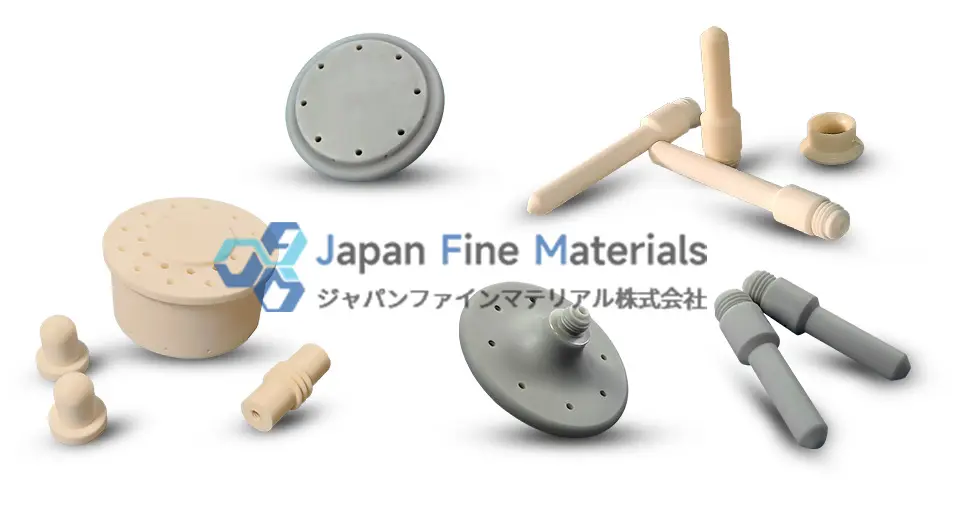
Excellent Heat and Corrosion Resistance
The primary reason Ceramic Nozzles maintain stable performance in plasma etching equipment over the long term is their exceptional adaptability to high-temperature environments and rapid temperature fluctuations. Plasma reaction chambers typically reach high temperatures during operation, and the regions where nozzles are located can be exposed to even greater temperature swings. Such continuous thermal shock places extremely strict demands on the structural stability of the material.
If the thermal stability of the material is insufficient, issues such as non-uniform thermal expansion, accumulation of micro-cracks, or micro-deformation of the nozzle orifice can easily occur. This results in gas flow drift, non-uniform etching distribution, and potential process interruptions. In advanced processes where strict dimensional accuracy of microstructures is required, these are top-priority factors to consider.
From this perspective, engineering ceramics (e.g., Alumina, Aluminum Nitride) maintain dimensional and structural stability under high-temperature cycles due to their relatively low thermal expansion coefficients and excellent thermal shock resistance. Meanwhile, Zirconia is suitable for conditions requiring resistance to mechanical impact, leveraging its high toughness and wear resistance. This ensures that the nozzle's geometry, jet angle, and gas distribution are maintained consistently over time, leading to guaranteed etching uniformity and production stability.
Furthermore, high-purity ceramics exhibit high chemical inertness against the highly corrosive process gases used in etching, such as halogen-based active gases. They maintain surface integrity even under prolonged ion bombardment and chemical corrosion. This not only extends the nozzle's lifespan but also reduces the risk of particle contamination caused by material sputtering, leading to fewer wafer defects. This is particularly effective in advanced process conditions sensitive to particle management.
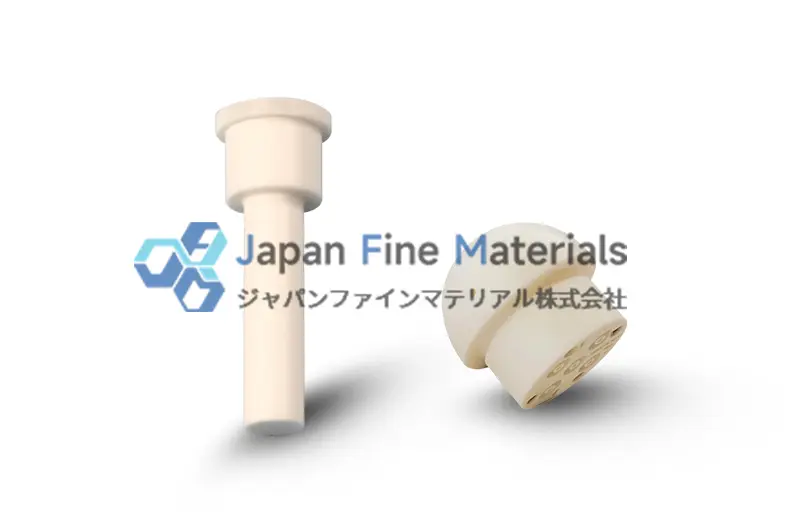
Improving Etching Precision and In-Plane Uniformity
In the plasma etching process, the stability of gas flow distribution determines the processing precision of microstructures. Ceramic nozzles, with their high machining accuracy and stable material microstructure, achieve uniform gas supply to the wafer surface, contributing to high consistency in etching patterns. This is especially important for MEMS devices, semiconductor chips, and microelectronic components, where even a slight deviation in flow can cause local over-etching or under-etching, affecting device performance and yield.
Additionally, the internal flow path surfaces of ceramic nozzles possess high smoothness, resulting in extremely low particle generation and minimal fluctuations in flow resistance. As a result, the gas injection direction is more stable, contributing to the balance of plasma density distribution within the reaction chamber. Under high-energy plasma, the stability of gas flow significantly reduces micro-defects on the wafer surface and ensures process repeatability. In advanced nodes, this precise control of the flow field is particularly critical and directly linked to product functionality and performance.
● Micron-level Nozzle Hole Machining Accuracy: Uniforms gas conduction and precisely controls the etching range.
● Stable Gas Flow Distribution: Suppresses local over-etching/under-etching and improves wafer in-plane consistency.
● Smooth Flow Path Design: Reduces particle generation and flow resistance fluctuations, enhancing process stability.
Through these characteristics, ceramic nozzles not only ensure processing precision in plasma etching but also contribute to improved product yields, providing a reliable foundation for advanced semiconductor and microelectronics manufacturing.
Extended Lifespan and Reduced Maintenance Costs
In plasma etching equipment, the service life of the nozzle is directly linked to production efficiency and operating expenses (OPEX). Conventional metal or plastic nozzles are prone to wear, cracking, or chemical corrosion in environments subject to high temperatures and high-energy ion bombardment, requiring frequent replacement. This leads to increased equipment downtime and maintenance costs. In contrast, ceramic nozzles, with their high wear resistance and excellent chemical stability, can operate stably for long periods even under harsh conditions, extending component life.
The wear resistance of Ceramic Nozzles maintains the stability of nozzle hole dimensions and gas flow distribution over long-term use, ensuring etching uniformity. They reduce process fluctuations caused by degraded nozzle performance. Furthermore, because ceramic materials have low sputtering rates, they suppress the risk of particle contamination, leading to a reduction in wafer scrap and the frequency of reaction chamber cleaning. This means fabs can operate equipment for longer cycles without frequent shutdowns for inspection or nozzle replacement, contributing to the optimization of production and maintenance schedules.
● Superior Plasma Bombardment Resistance: Minimizes wear on the nozzle inner walls even under high-energy plasma impact.
● Excellent Chemical Stability: Maintains stability against corrosive gases like halogens, suppressing part damage and particle generation.
● Predictable Maintenance Cycles: Reduces the number of equipment shutdowns and optimizes production continuity.
● Reduction in Total Cost of Ownership (TCO): Beyond extending nozzle life, it reduces potential losses associated with downtime, cleaning, and scrap.
These characteristics make ceramic nozzles not only a contributor to the long-term stable operation of etching equipment but also a key core component in high-end semiconductor manufacturing that improves the overall production efficiency and economy of the production line.
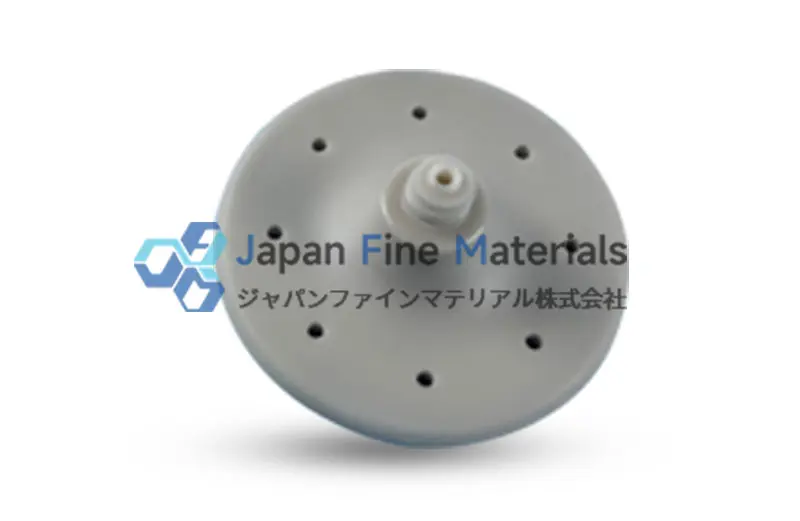
Suppression of Process Contamination and Improvement of Cleanliness
In semiconductor manufacturing, chamber cleanliness is a critical factor affecting product yield. The release of minute particles or chemical contamination can lead to wafer scrap or device failure. Ceramic nozzles, with their highly dense structure and excellent chemical inertness, maintain surface integrity and smoothness even in harsh environments such as high-temperature/high-energy plasma and highly corrosive gases, significantly reducing process contamination risks.
High-purity ceramic nozzles generate extremely few particles during etching and are unlikely to have undesirable reactions with active process gases such as CF₄, SF₆, or Cl₂. This characteristic is particularly important for precision processing in microelectronics and advanced nodes. By maintaining the cleanliness of the nozzle flow path and the stability of gas flow, they not only ensure etching pattern accuracy but also effectively avoid secondary contamination of the wafer, contributing to process consistency and final yield improvement.
● Highly Dense Surface Structure: Suppresses particle adhesion and accumulation in the gas stream, improving overall process cleanliness.
● Excellent Chemical Inertness: Prevents undesirable reactions with process gases, reducing the risk of wafer contamination from by-products.
● Stable Gas Flow: Contributes to uniform plasma distribution and reduces local defect rates.
● Suitability for Advanced Processes: Guarantees consistency in microstructure processing at nanometer-level nodes.
Key Points for Design and Selection
In a plasma etching system, the design of the ceramic nozzle not only affects durability but also directly influences the jet morphology, plasma density distribution, and in-plane etching uniformity. Therefore, when selecting a nozzle, it is necessary to comprehensively consider the purity of the ceramic material, mechanical properties, gas dynamics characteristics, plasma resistance, and compatibility with the equipment structure. Engineering teams typically evaluate the following key aspects carefully:
● Material Stability and Applicability
Nozzle materials must have plasma erosion resistance, heat resistance, and low particle generation (suppression of particle shedding). High-purity Alumina (Al₂O₃), Aluminum Nitride (AlN), or Zirconia (ZrO₂) are selected based on the process temperature window and the types of gases used (chemical environment) to suppress the degradation of the ceramic component over time.
● Nozzle Flow Path Design
The flow path diameter, taper angle, and exit shape greatly influence the uniformity of gas diffusion. Improper design can lead to local excesses or deficiencies in plasma density, causing in-plane variations in the etching rate and reducing processing precision.
● Dimensional Accuracy and Integration Compatibility
The nozzle must be precisely matched with the chamber's gas piping interface, mounting seat, and overall flow field design. Even a slight deviation in tolerance can destabilize gas flow or alter local electric field distribution, so high machining accuracy is a critical selection metric.
● Superior Corrosion Resistance
It is essential for the ceramic nozzle to maintain high chemical stability in highly corrosive process atmospheres like fluorine or chlorine-based gases. If surface roughening or microscopic etching progresses, it can become a factor that disrupts the flow field and plasma quality.
● Customization Capability
Plasma etching equipment varies by model in terms of chamber structure, mounting interfaces, and gas system layouts. Custom ceramic nozzle solutions allow for higher suitability and process compatibility.
Conclusion
In plasma etching equipment, ceramic nozzles are critical components directly linked to controlling gas flow distribution, maintaining stable plasma shapes, and ensuring etching uniformity, particle control, and process reliability. High-quality ceramic nozzle solutions contribute to improved process stability, extended equipment maintenance cycles, and reduced particle contamination risks, achieving high yields and excellent cost efficiency in semiconductor manufacturing.
If you are looking for high-performance ceramic nozzles for plasma etching equipment, or have requirements for custom structural design, material selection, or technical optimization, please contact JFM. JFM has a wealth of experience in the manufacture and precision machining of high-purity fine ceramics, and in the supply of core components for etching equipment, supporting the realization of more reliable and precise advanced processes.
Contact JFM today to discuss custom ceramic nozzle solutions and technical support.
FAQ
Q1: What temperature can ceramic nozzles withstand in plasma etching?
High-quality engineering ceramics such as Alumina (Al₂O₃) and Silicon Nitride (Si₃N₄) have excellent heat resistance and adapt to the high-temperature reaction environments in plasma etching processes. They can maintain structural stability even under continuous thermal cycling conditions.
Q2: Which ceramic nozzle is suitable for which gas atmosphere?
Ceramic nozzles exhibit high chemical stability (inertness) against many corrosive process gases. they are compatible with fluorine-based gases (SF₆, CF₄), chlorine-based gases (Cl₂), and oxidizing gases (O₂), allowing for long-term stable use in complex chemical atmospheres.
Q3: What is the typical lifespan of a nozzle?
The lifespan of a ceramic nozzle depends heavily on factors such as process conditions, plasma intensity, gas types, and cleaning/maintenance status. Generally, high-wear-resistance ceramic nozzles are suitable for long-term continuous operation. Periodic inspection of nozzle hole wear and deposits helps in evaluating and extending the lifespan.
Q4: Does the use of ceramic nozzles cause particle contamination?
Highly dense ceramic materials have low sputtering rates and tend to generate fewer particles even under plasma ion bombardment. This contributes to maintaining high chamber cleanliness and stabilizing the etching process.
Q5: Can ceramic nozzles be customized?
Yes. We can customize various parameters such as nozzle hole shape, diameter, length, material, and surface roughness (finish) to match the equipment chamber structure and optimize the design for equipment and process requirements.
Q6: How can the long-term performance stability of ceramic nozzles be maintained?
During use, avoid strong mechanical shocks and uncontrolled thermal shocks (rapid cooling/heating), and perform cleaning according to specified procedures. Additionally, it is important to periodically check for nozzle hole wear or clogging and operate in environments compatible with the materials.
Q7: What are the advantages of ceramic nozzles compared to metal nozzles?
Ceramic nozzles generally offer superior heat resistance, corrosion resistance, and wear resistance, as well as high dimensional stability. Under appropriate process conditions, they contribute to improved etching repeatability/uniformity and wafer yield, while also reducing the frequency of consumable replacement and maintenance costs.