Silicon Carbide Ceramics: Composition, Properties, and industry Applications
-
2026-08-06 Industry News






Silicon Carbide Ceramics: composition, key properties, and industrial applications in high-temperature, high-strength, and wear-resistant environments.
Introduction
In the field of advanced engineering ceramics, silicon carbide ceramics have become a critical material in numerous industrial applications due to their exceptional high-temperature resistance, wear resistance, and chemical stability. From semiconductor manufacturing equipment to high-temperature kiln systems, and from chemical processing equipment to the new energy sector, an increasing number of engineering applications are adopting silicon carbide ceramics as a replacement for traditional metallic materials or conventional ceramic materials.
Compared to many common engineering materials, silicon carbide ceramics are capable of maintaining excellent performance under complex operating conditions—such as high temperatures, corrosion, and wear—and are therefore widely used in industrial environments with stringent material performance requirements. Understanding their composition, core properties, and industrial applications provides valuable guidance for material selection and equipment design.
What Are Silicon Carbide Ceramics?
Silicon carbide ceramics areceramic materials They are typically fabricated through processes such as reaction sintering, unpressurized sintering, recrystallization or hot-press sintering advanced structural primarily composed of silicon carbide (SiC), which may include α-SiC or β-SiCcrystal forms such as.,. Silicon carbide itself is a compound formed by the covalent bonding of silicon and carbon atoms, characterized by high hardness and excellent thermal properties.
Depending on the manufacturing process and microstructure, the mainstream silicon carbide ceramics used in the industrial sector can be classified into the following categories:
|
Type |
Characteristics |
|
Reaction-Sintered Silicon Carbide (RBSC/RBSiC) |
High density and good dimensional control |
|
Unpressed Sintered Silicon Carbide (SSiC) |
High purity, outstanding corrosion resistance |
|
Recrystallized Silicon Carbide (RSiC) |
Optimal high-temperature resistance (≥1600°C), but lower density |
|
Hot-pressed silicon carbide (HPSiC) |
Extremely high density, suitable for special operating conditions |
Different types of silicon carbide ceramics exhibit certain differences in mechanical properties, thermal properties, and application areas; therefore, the selection process requires an evaluation based on specific operating conditions.
Composition of Silicon Carbide Ceramics
The core component of silicon carbide ceramics is the silicon carbide (SiC) crystal, whose theoretical chemical formula is SiC, formed by the bonding of silicon and carbon atoms through strong covalent bonds. This unique atomic structure endows the material with high hardness, good thermal conductivity, and excellent wear resistance.
During the actual production process, to enhance sintering efficiency, control the microstructure, or improve density, small amounts of additives are typically added based on the material system. Examples include:
• Boron (B)
• Carbon (C)
• Aluminum oxide (Al₂O₃)
• Yttrium oxide (Y₂O₃)
The role of additives or components depends on the sintering route and formulation system; they can be used theseto promote densification , regulate grain boundary structure , or improve specific properties.
From a microstructural perspective, silicon carbide ceramics consist of a large number of fine grains; grain size, distribution uniformity, and porosity all influence material performance. Generally, silicon carbide ceramics with higher density and lower porosity exhibit superior strength, wear resistance, and corrosion resistance. Therefore, raw material quality, particle control, and sintering processes directly affect the performance and application scope of the final product.
Properties of Silicon Carbide Ceramics
High Hardness and Wear Resistance
Among common engineering ceramics, it is a material with high hardness. Its Mohs hardness is typically around 9–9.5, making it suitable for a variety of wear-resistant applications.
These properties make it suitable for applications involving particle erosion, sliding wear, or prolonged friction; silicon carbide ceramics generally exhibit excellent wear resistance.
Excellent High-Temperature Resistance
Silicon carbide ceramics can operate in high-temperature environments and are therefore widely used in high-temperature industrial equipment.
Their good dimensional stability in high-temperature environments enables them to meet the requirements of certain specialized process equipment.
Good thermal conductivity
Compared to many traditional ceramics, silicon carbide ceramics have higher thermal conductivity.
This facilitates rapid heat transfer and reduces localized heat buildup, making them highly valuable for applications in semiconductor equipment and thermal management systems.
Excellent thermal shock resistance
The low coefficient of thermal expansion of silicon carbide ceramics (approximately 4.0–4.5 × 10⁻⁶/°C), combined with their high thermal conductivity, enables them to effectively reduce thermal stress during drastic temperature changes, resulting in excellent thermal shock resistance.
This is crucial for precision equipment and high-temperature equipment that require frequent heating and cooling cycles.
Excellent Corrosion Resistance
Silicon Carbide Ceramics can be used in a variety of corrosive or abrasive environments, such as in chemical processing, environmental protection, and desulfurization equipment .
In acidic, alkaline, or partially oxidizing environments, silicon carbide ceramics typically exhibit good chemical stability.
Manufacturing Process of Silicon Carbide Ceramics
The properties of silicon carbide ceramics depend not only on the raw materials but are also closely related to the manufacturing process.
A typical production process includes:
Raw Material Preparation
Screening, mixing, and particle size control of silicon carbide powder.
Forming Process
Depending on the product’s shape and dimensional accuracy requirements, forming methods such as dry pressing, cold isostatic pressing, slip casting, extrusion, and gel casting may be employed.
High-Temperature Sintering
The sintering process is the core step that determines the final properties of silicon carbide ceramics. Depending on the material type:
• SSiC is typically sintered using pressureless sintering ( ); for applications requiring exceptionally high density, this may be combined with a subsequent densification process
• RBSC uses reaction sintering
• RSiC uses recrystallization sintering
• HPSiC is sintered using hot-press sintering
Precision Machining
Sintered silicon carbide has high hardness, so precision machining typically requires methods such as diamond grinding and lapping.
Common machining operations include:
• Flat grinding
• Internal and external cylindrical grinding
• Hole Drilling
• Precision dimensional finishing
Industrial Applications of Silicon Carbide Ceramics
Thanks to their high-temperature resistance, wear resistance, and excellent chemical stability, silicon carbide ceramics are used in certain industrial sectors that demand high material performance. Based on their structural and performance characteristics, their common applications primarily include the following areas:
Semiconductor Equipment
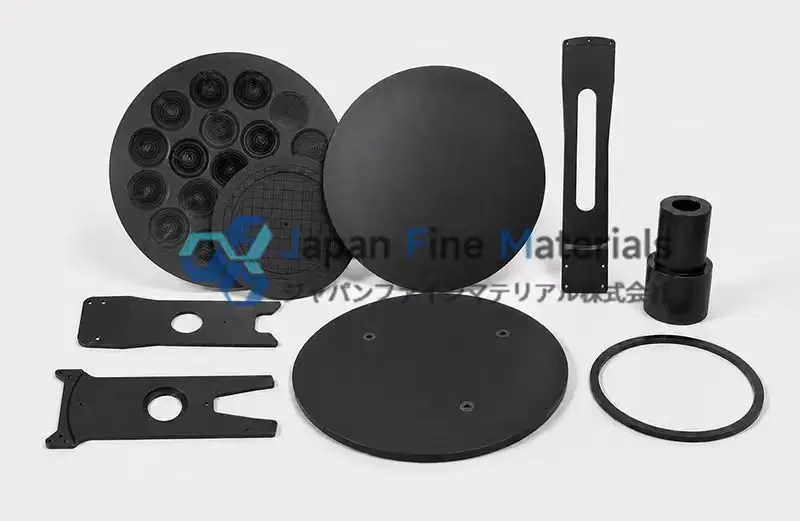
In the semiconductor manufacturing process, certain silicon carbide ceramic components are used in wafer processing and process equipment, such as carrier trays, support structures, and certain corrosion-resistant structural components.
Industrial Furnace Equipment
Due to their excellent high-temperature performance, silicon carbide ceramics are commonly used in kiln systems for products such as crossbeams, rollers, and high-temperature-resistant support components.
Chemical and Environmental Protection Equipment
In equipment exposed to corrosive media or abrasive environments, silicon carbide ceramics can be used for certain corrosion- and wear-resistant components, helping to meet operational requirements under complex conditions.
Wear-Resistant Industrial Components
Due to their high hardness, silicon carbide ceramics can also be used in wear-resistant components such as nozzles and sealing rings, offering significant value in environments subject to particle erosion and friction.
How to Select the Right Silicon Carbide Ceramics?
When selecting silicon carbide ceramics, it is recommended to focus on the following aspects:
|
Evaluation Factors |
Key Considerations |
|
Long-Term Operating Temperature |
Determine the continuous operating temperature, peak temperature, and frequency of thermal cycling |
|
Corrosive Environment |
The acidity/alkalinity, concentration, and temperature of the medium, as well as the presence of abrasive particles. |
|
Wear Conditions |
Particle erosion, sliding wear, and loading conditions |
|
Dimensional Accuracy |
Tolerance requirements |
|
Product structure |
Complexity |
|
Service Life Requirements |
Maintenance Schedule Planning |
|
Cost Budget |
Total Cost of Ownership |
Material types and manufacturing processes may vary depending on operating conditions, so it is crucial to conduct a thorough evaluation early in the project.
Silicon Carbide Ceramics vs. Silicon Carbide Ceramics
Silicon Carbide Ceramics (SiC) and Aluminum Oxide Ceramics (Al₂O₃) are both widely used engineering ceramic materials; however, due to differences in crystal structure and bonding mechanisms, they exhibit distinct differences in thermal properties, mechanical behavior, and typical applications.
|
VS |
Silicon Carbide Ceramics (SiC) |
Alumina (Al₂O₃) |
|
Crystal Structure Characteristics |
Strong covalent bonding structure with high lattice binding energy |
Hybrid structure of ionic and covalent bonds |
|
Thermal Conductivity |
Typically at a high level, facilitating rapid heat conduction |
Lower thermal conductivity, with properties more suited to thermal insulation |
|
Thermal shock stability |
Generally better suited for involving rapid temperature changes or operating conditions large temperature gradients |
More sensitive to rapid temperature changes |
|
Wear resistance mechanism |
High hardness and low wear rate, suitable for environments subject to particle erosion |
Depending on hardness, wear performance depends on operating conditions |
|
Electrical Properties |
Semiconductor Properties (Vary with Purity and Structure) |
Excellent electrical insulator |
|
Machining Characteristics |
High hardness; machining requires diamond tools |
Greater processing maturity and a wider process window |
|
Application-Oriented |
High-temperature, thermal management, and severe wear conditions |
Primarily for insulating structural components and general-purpose industrial parts |
Conclusion
As a key representative of advanced ceramic materials, silicon carbide ceramics—with their high hardness, wear resistance, high-temperature resistance, excellent thermal conductivity, and chemical stability—have been widely adopted in various fields, including semiconductors, new energy, chemical processing, environmental protection, and industrial furnaces.With the rapid development of emerging industries such as third-generation semiconductors, photovoltaics, and energy storage, the application scope of silicon carbide ceramics in high-end precision equipment and harsh operating conditions will continue to expand.
If you are looking for a silicon carbide ceramics solution suited to your operating scenarios, drawings, and operating conditions, please feel free to contact JFM. Based on your applicationconditions, our team can provide material selection recommendations and customized ceramic component support, helping to improve project selection efficiency and application stability.