What Is Aluminum Nitride Ceramic? A Comprehensive Guide
-
2026-08-06 Industry News






Learn what aluminum nitride ceramic is, its key properties, manufacturing process, applications, advantages, limitations, and how to choose the right material.
Introduction
With the development of industries such as semiconductors, new energy vehicles, 5G communications, and power electronics, related equipment has placed higher demands on materials in terms of thermal conductivity, electrical insulation, and high-temperature resistance. While traditional metallic materials offer good thermal conductivity, their electrical insulation capabilities are limited; conversely, some common ceramics provide excellent insulation but struggle to meet the thermal conductivity requirements of certain applications.
Against this backdrop, Aluminum nitride ceramics have gradually gained significant attention as an advanced ceramic material in electronic packaging, semiconductor equipment, and high-end industrial sectors. It combines high thermal conductivity, excellent electrical insulation, and a low coefficient of thermal expansion, making it highly valuable in applications that require both heat dissipation and electrical isolation.
What Are Aluminum Nitride Ceramics?
Aluminum nitride ceramics are an advanced engineering ceramic material primarily made from aluminum nitride (AlN) powder and produced through processes such as molding, sintering, and precision machining. They belong to the category of non-oxide ceramics and, like materials such as alumina, zirconia, and silicon carbide, are part of the advanced ceramic family; however, due to differences in composition and crystal structure, their specific applications vary.
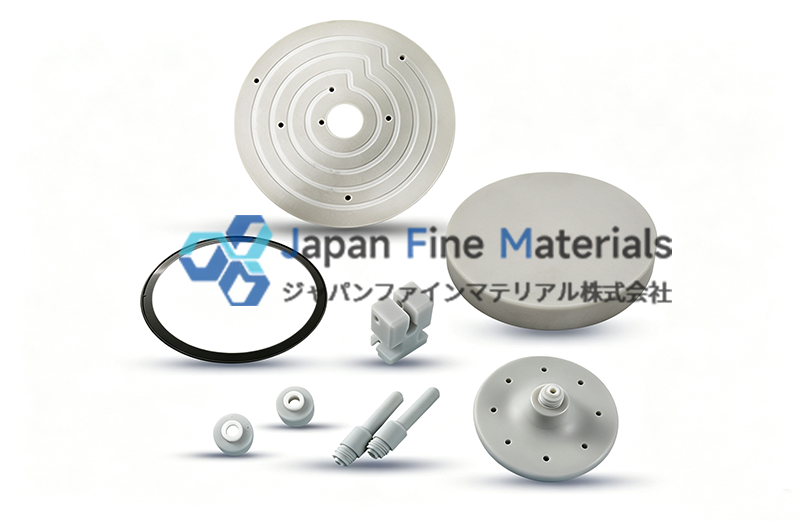
From a material perspective, aluminum nitride is a compound composed of aluminum and nitrogen with a hexagonal zincblende crystal structure. This structure endows the material with excellent thermal conductivity while maintaining high electrical insulation properties, making it widely sought after in electronic packaging, thermal management, and precision industrial equipment.
Compared to conventional structural ceramics, aluminum nitride ceramics place greater emphasis on balancing thermal management and electrical insulation requirements, and are therefore frequently used in industrial applications that demand high comprehensive material performance. With the development of industries such as semiconductors, new energy vehicles, and high-power electronics, aluminum nitride ceramics the scope of application forcontinues to expand, and they have become an important component of advanced ceramic materials.
Performance Characteristics of Aluminum Nitride Ceramics
High Thermal Conductivity
Thermal conductivity is one of the key reasons why aluminum nitride ceramics have garnered significant attention.
Compared to most traditional oxide ceramics, aluminum nitride ceramics can conduct heat generated during operation more quickly, helping to improve the thermal dissipation efficiency of devices; therefore, they are commonly used in high-power electronic devices and thermal management systems.
Good Electrical Insulation Properties
In addition to their thermal conductivity, ’s aluminum nitride ceramics also exhibit excellent volume resistivity and dielectric properties.
This combination of thermal conductivity and electrical insulation makes them suitable for applications requiring both electrical isolation and heat transfer, such as:
• Power electronic modules
• Power supply modules
• LED heat sink substrates
• High-frequency electronic devices
Low coefficient of thermal expansion
The coefficient of thermal expansion of aluminum nitride ceramics is relatively close to that of semiconductor materials such as silicon.
During temperature changes, it helps reduce thermal stress caused by differences in thermal expansion, which is of some reference value for electronic packaging and chip packaging design.
Good high-temperature resistance
Under appropriate process conditions, aluminum nitride ceramics can withstand high temperatures and are therefore suitable for use in certain high-temperature manufacturing equipment and heat treatment-related components.
However, during long-term use in high-temperature air environments, their oxidation must be evaluated in conjunction with specific operating conditions; therefore, in practical applications, design solutions are typically selected based on the specific operating environment.
Good Chemical Stability
Aluminum nitride ceramics exhibit good chemical stability under conditions such as dry, vacuum, or controlled atmospheres; however, when exposed to humid, strongly acidic or alkaline, or high-temperature oxidizing environments, their performance must be evaluated based on specific operating conditions.
Therefore, aluminum nitride ceramics also have an established basis for application in semiconductor manufacturing, vacuum equipment, and certain types of chemical processing equipment.
Manufacturing Process of Aluminum Nitride Ceramics
The performance of aluminum nitride ceramics depends not only on the material itself but is also closely related to the manufacturing process. From raw material processing to final precision machining, every step affects the product’s thermal conductivity, density, dimensional accuracy, and surface quality. Therefore, in the manufacturing of advanced ceramics, strict control over each process step is typically required to meet the performance requirements of different applications.
Raw Material Preparation
Manufacturing typically begins with high-purity aluminum nitride powder. To enhance sintering performance, an appropriate amount of sintering aids is added according to product requirements. Processes such as ball milling and blending are used to achieve a more uniform particle size distribution, thereby creating a solid foundation for subsequent forming and sintering.
Forming
Depending on the product’s structure, dimensions, and batch size requirements, different forming processes can be selected, such as:
• Dry Pressing
• Isostatic pressing
• Injection Molding
• Cast Molding
Different forming methods are suitable for different types of products. For example, parts with simple structures are often produced using dry pressing or isostatic pressing, while thin-sheet substrates and some products with complex structures require the selection of a more suitable forming process based on design requirements.
Degreasing
Green bodies containing organic binders require degreasing. This process is primarily used to remove organic materials added during the forming process, ensuring a more uniform green body structure for subsequent sintering and minimizing sintering defects caused by residual organic matter.
High-Temperature Sintering
Sintering is a critical step in the manufacturing process of aluminum nitride ceramics. High-temperature sintering is typically performed under a protective atmosphere such as nitrogen,, to allow the ceramic particles to gradually bond and achieve densification. Process parameters such as sintering temperature, holding time, and atmosphere control all affect the material’s thermal conductivity, mechanical properties, and microstructure; therefore, process optimization is usually required based on product specifications.
Precision Machining
Because sintered aluminum nitride ceramics have high hardness, precision machining is typically required to achieve the final dimensions and surface finish, including:
• Precision Grinding
• CNC Machining
• Laser Machining
• Polishing
These follow-up processes help meet the requirements of various products in terms of dimensional tolerances, surface roughness, and assembly accuracy, making them suitable for semiconductor equipment, electronic packaging, and other precision industrial applications.
Typical Applications of Aluminum Nitride Ceramics
Semiconductor Equipment
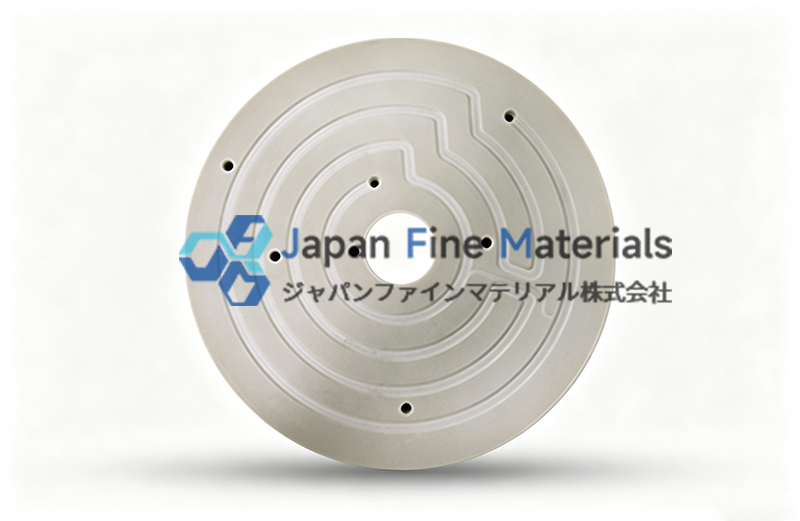
In the semiconductor manufacturing process, equipment components typically need to balance thermal conductivity, electrical insulation, and dimensional stability.
Aluminum nitride ceramics can be used in:
• Components for electrostatic chucks
• Ceramic components for vacuum equipment
• Ceramic components for heating platforms
• Insulating structural components for semiconductor equipment
Power electronics modules
Advances in new energy vehicles, power supply equipment, and industrial control systems have placed higher demands on the heat dissipation capabilities of power modules.
Aluminum nitride ceramics can be used as:
• DBC/AMB ceramic substrate materials
• Heat dissipation substrates for power modules
• Ceramic substrates for IGBT modules
• Insulating substrates for power devices
LED thermal management systems
High-power LEDs generate a significant amount of heat during operation.
The use of ceramic materials with high thermal conductivity helps improve heat transfer efficiency; therefore, aluminum nitride ceramics are also used in some LED packages and heat dissipation substrates.
Communications Electronics
In 5G communications, RF equipment, and high-frequency electronic products, thermal management is just as important as electrical insulation.
Aluminum nitride ceramics can be used in:
• High-frequency modules
• Microwave devices
• Communications Substrates
• RF electronic components
Laser and optoelectronic equipment
Some laser equipment and optoelectronic systems require a balance between thermal management and structural stability.
Aluminum nitride ceramics can meet the comprehensive material performance requirements of certain precision equipment and are therefore also used in related structural components and substrate products.
How to Select the Right Aluminum Nitride Ceramics?
Performance requirements for aluminum nitride ceramics vary across different application scenarios. Therefore, when selecting a product, in addition to considering the material itself, a comprehensive evaluation should be conducted that takes into account the product structure, processing requirements, and actual operating conditions. For fields such as electronic packaging, semiconductor equipment, or power electronics, clearly defining technical requirements early on facilitates subsequent product development and application.
Does the thermal conductivity meet application requirements:
Different products have varying heat dissipation requirements; the appropriate material grade should be selected based on device power, operating environment, and thermal management design.
Dimensional accuracy and machining capabilities:
If the product involves complex structures, micro-holes, irregular contours, or high assembly precision, verify that the supplier possesses the corresponding precision machining capabilities.
Material Purity and Sintering Quality:
High-quality powder raw materials and a proven sintering process help achieve a more uniform microstructure, providing a solid foundation for product performance.
Compatibility with Operating Environments:
Evaluate the material’s suitability based on actual operating conditions, such as operating temperature, vacuum environment, humidity, and whether the material will come into contact with chemical media.
Product Consistency and Bulk Supply Capability:
For mass production projects, focus on the supplier’s overall performance in quality control, production capacity, and delivery reliability.
Technical Support and Customization Capabilities:
When products require special dimensions, complex structures, or customized designs, suppliers with engineering collaboration and custom processing capabilities are typically better equipped to support project development.
For procurement personnel and product engineers, providing information such as product drawings, dimensional requirements, operating environments, and performance targets early in the project helps suppliers offer more relevant material and processing solutions tailored to the specific application, thereby improving product development efficiency.
Conclusion
Aluminum nitride ceramics are an advanced engineering ceramic material that combines thermal conductivity with electrical insulation properties, offering significant application value in fields such as semiconductor equipment, power electronics, communications electronics, LED heat dissipation, and optoelectronic devices. Their performance is not only determined by the material itself but is also influenced by multiple factors, including powder quality, sintering processes, and precision machining; therefore, a comprehensive evaluation based on specific application requirements is necessary when selecting products.
If you are looking for aluminum nitride ceramic products or custom machining solutions, JFM offers a wide range of advanced ceramic components and custom machining services. Please feel free to contact our technical team. We will provide guidance on material selection and manufacturing solutions based on your product requirements, drawings, and application scenarios.