Aluminum Nitride Ceramic Ring: Properties, Benefits and Uses
-
2026-09-29 Industry News






Explore alumina ceramic vacuum chucks, including their key properties, structural features, vacuum holding performance and applications in semiconductor manufacturing.
Introduction
In semiconductor manufacturing equipment, ceramic components often must simultaneously meet requirements such as temperature fluctuations, electrical insulation, dimensional fit, and complex process environments. For ring-shaped structural components, the choice of material not only affects the performance of the component itself but also influences its fit with surrounding components.
Aluminum nitride ceramics, with their high thermal conductivity, electrical insulation, and low coefficient of thermal expansion, are increasingly being used in equipment structures that require effective thermal management and insulation performance. This article will material properties, application scenarios, material comparisons and selection criteriaintroduce the characteristics and practical applications of aluminum nitride ceramic Rings from the perspectives of.
What Is an Aluminum Nitride Ceramic Ring?
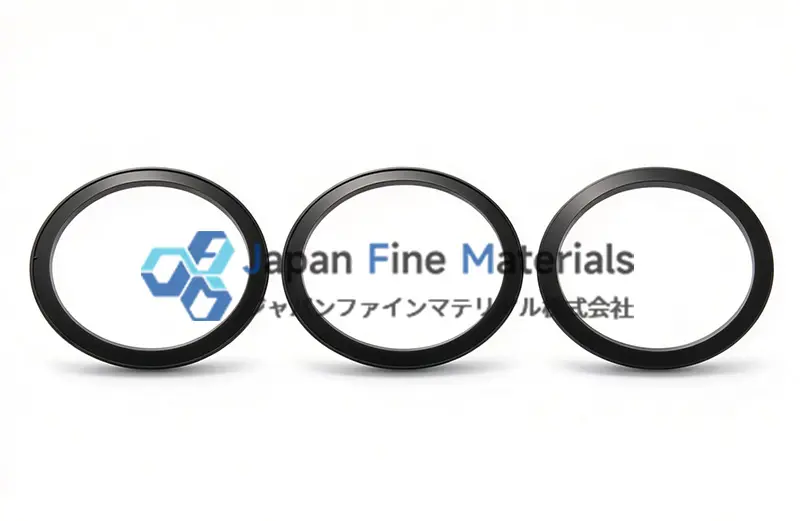
An aluminum nitride ceramic Ring is a ring-shaped component machined from aluminum nitride ceramic material. Its basic structure is relatively simple, but actual products can be designed with varying outer diameters, inner diameters, thicknesses, hole positions, and stepped structures to suit specific equipment designs.
Aluminum nitride itself is an engineering ceramic material with high thermal conductivity (typically 140–200 W/(m·K)) and a relatively moderate coefficient of thermal expansion (approximately 4.5–5.5 × 10⁻⁶/K at 25–1000°C), which is lower than that of alumina (approximately 7–8 × 10⁻⁶/K) but higher than that of some low-expansion ceramics. They also possess electrical insulation properties. These material characteristics enable their use in equipment components that are sensitive to heat transfer, electrical isolation, and dimensional changes.
For semiconductor equipment, the Ceramic Ring is not merely a simple ring-shaped structure. In practical applications, factors such as clearances between adjacent components, assembly methods, surface roughness, and operating temperature must also be considered. Therefore, material selection typically needs to be integrated with the specific structural design.
Key Properties of Aluminum Nitride Ceramic Rings
High Thermal Conductivity
One of the most notable material characteristics of aluminum nitride is its high thermal conductivity. Compared to some common oxide ceramics, aluminum nitride exhibits distinct material properties in terms of heat conduction.
For certain thermal management structures in semiconductor equipment, a material’s thermal conductivity affects heat transfer between components. aluminum nitride ceramic Rings can participate in heat transfer or thermal field management based on their specific structure, thereby meeting the temperature control requirements of certain equipment designs.
It should be noted that actual thermal performance is also influenced by factors such as material purity, sintering processes, porosity, and product structure; therefore, the thermal performance of the final component cannot be determined solely based on the material name.
Electrical Insulation Properties
Aluminum nitride is an electrically insulating ceramic material that also possesses good thermal conductivity.
This combination of properties is valuable for equipment designs that require electrical isolation while also considering heat transfer. For example, in certain semiconductor equipment, components must both minimize unnecessary conductive paths and dissipate heat generated during operation; in such cases, aluminum nitride can serve as one of the material solutions.
Low Coefficient of Thermal Expansion
When temperatures change, ceramic materials undergo a certain degree of dimensional change. Aluminum nitride has a relatively low coefficient of thermal expansion, a characteristic worth noting in equipment environments with significant temperature fluctuations.
For precision Ceramic Rings, dimensional changes not only affect the component itself but may also impact its fit with other parts. Therefore, when designing aluminum nitride ceramic Rings, it is necessary to comprehensively consider operating temperature, dimensional tolerances, and assembly clearances.
Suitability for High-Temperature Applications
Aluminum nitride ceramics possess good high-temperature resistance and can therefore be used in certain high-temperature equipment components.
In semiconductor manufacturing, some processes involve high temperatures, so ceramic materials must be selected based on actual process conditions. For the aluminum nitride ceramic Ring, in addition to the material’s inherent temperature resistance, attention must also be paid to sintering quality, structural dimensions, surface condition, and thermal cycling conditions.
Chemical Stability
Aluminum nitride exhibits good resistance to certain chemical environments, making it suitable for use in some semiconductor equipment.
However, different process gases, plasma environments, and chemical media affect ceramic materials to varying degrees. For equipment involving corrosive gases or plasma, material compatibility must be evaluated based on specific process conditions rather than determined solely by material type.
For which semiconductor equipment are Aluminum Nitride Ceramic Rings suitable?
Aluminum nitride ceramic rings are primarily used in semiconductor equipment and wafer handling components that have specific requirements for thermal conductivity, electrical insulation, high-temperature resistance, or dimensional stability. Because aluminum nitride combines high thermal conductivity with electrical insulation properties, it can be used in various functional positions depending on the equipment’s structure.
Common related equipment and applications include:
• Etching equipment: Used in components requiring electrical insulation and resistance to plasma corrosion, such as RF feed-through insulation rings and chamber isolation rings .
• Thin-film deposition equipment: In certain CVD and PVD systems, it can serve as part of structures related to insulation, isolation, or thermal management.
• Wafer processing equipment: Depending on the structural design, it can be used for positioning, isolation, or auxiliary support components around the wafer.
• Heat treatment equipment: Utilizing aluminum nitride thermal conductivity and high-temperature resistance, it is used in structures related to partial heating and temperature management.
• Plasma processing equipment: For environments involving high temperatures, vacuum, and plasma, the suitability of the material must be evaluated in conjunction with specific processes.
• Wafer Heating and Temperature Control Components: The thermal conductivity of aluminum nitride enables its use in certain ceramic structures requiring heat transfer and temperature management.
It should be noted that the same aluminum nitride ceramic Ring may serve different functions in different types of equipment. When selecting a specific model, a comprehensive evaluation must be conducted, taking into account operating temperature, vacuum environment, process gases, dimensional tolerances, surface roughness, and assembly relationships with adjacent components.
Aluminum Nitride Ceramic Ring vs. Alumina Ceramic Ring
Aluminum nitride and aluminum oxide are both common engineering ceramic materials used in semiconductor equipment, but their material properties differ.
|
VS |
Aluminum Nitride Ceramic |
Ceramic |
|
Thermal Conductivity |
Higher |
Relatively low |
|
Electrical Insulation |
Good |
Good |
|
Coefficient of thermal expansion |
Low |
Relatively high |
|
Thermal management capability |
Suitable for structures with specific heat transfer requirements |
Suitable for a variety of conventional insulation structures |
|
Material cost |
Typically high |
Relatively easier to control |
|
Common Applications |
Thermal management, semiconductor equipment, high-temperature components |
Insulating components, structural components, semiconductor components |
Therefore, choosing between aluminum nitride and aluminum oxide is not simply a matter of determining which material is better, but rather requires a comprehensive evaluation based on the equipment’s thermal management, electrical insulation, dimensional accuracy, operating temperature, and cost requirements.
If the equipment has significant thermal conductivity requirements, aluminum nitride may be more suitable; if the primary requirements focus on conventional insulation and structural support, aluminum oxide may also be a suitable material solution.
What factors should be considered when selecting an aluminum nitride ceramic ring from?
When purchasing or designing an aluminum nitride ceramic ring with a , you can evaluate it based on the following aspects:
• Material Properties: Determine material requirements based on thermal conductivity, electrical insulation properties, coefficient of thermal expansion, and actual operating temperature.
• Dimensions and Tolerances: Specify key dimensions such as outer diameter, inner diameter, thickness, hole locations, flatness, and concentricity.
• Surface Finish: Determine surface roughness and surface treatment requirements based on the assembly method and operating environment.
• Operating Environment: Consider actual conditions such as temperature, vacuum, process gases, plasma, and chemical media.
• Assembly Method: Focus on the fit between the Ceramic Ring and metal, ceramic, or other components.
• Volume Requirements: If the product is used in mass-produced equipment, consider dimensional consistency, production cycles, and supply coordination methods simultaneously.
Therefore, selecting an aluminum nitride ceramicRing involves more than simply specifying a material name and dimensions; it requires a comprehensive evaluation that integrates material, structure, machining, and actual operating conditions.
Conclusion
The application value of aluminum nitride ceramic Rings primarily stems from the material inherent properties, such as thermal conductivity, electrical insulation, thermal expansion, and high-temperature tolerance. For semiconductor equipment, the decision to use aluminum nitride ceramic Rings must be made based on the specific process environment, equipment structure, and component functions.
If you are seeking an aluminum nitride ceramic Ring, or need with ceramic material selection and component design evaluation tailored to your existing equipment structureassistance, JFM offers comprehensive services ranging from material selection and structural design collaboration to manufacturing and supply coordination. If you have specific product requirements or project proposals that require discussion, please contact JFM to further explore suitable ceramic component solutions.