What are Porous Ceramics: Characteristics and Industrial Advantages
-
2026-01-30 Industry News






Porous ceramics combine a controlled microstructure with strength and stability. Essential for filtration and semiconductors, they balance porosity and durability for modern precision engineering and high-performance components.
Introduction
Porous Ceramics are advanced materials that combine structural and functional properties. In modern manufacturing processes, requirements for lightweight design, high-temperature resistance, corrosion resistance, and ultra-clean environments continue to rise. Traditional dense ceramics often struggle to meet these complex performance requirements in certain applications. In this context, porous ceramics have gained significant attention as an effective solution that balances strength, adsorption, permeability (breathability), and thermal stability through their unique internal pore structures.
By precisely controlling pore size, porosity, distribution, and interconnectivity, porous ceramics can perform functions such as separation, filtration, thermal insulation, and sound absorption while maintaining long-term structural stability under harsh conditions. Consequently, their importance is growing in advanced manufacturing fields such as semiconductor wafer handling systems, ultra-high-purity gas supply, vacuum stages, and energy conversion devices.
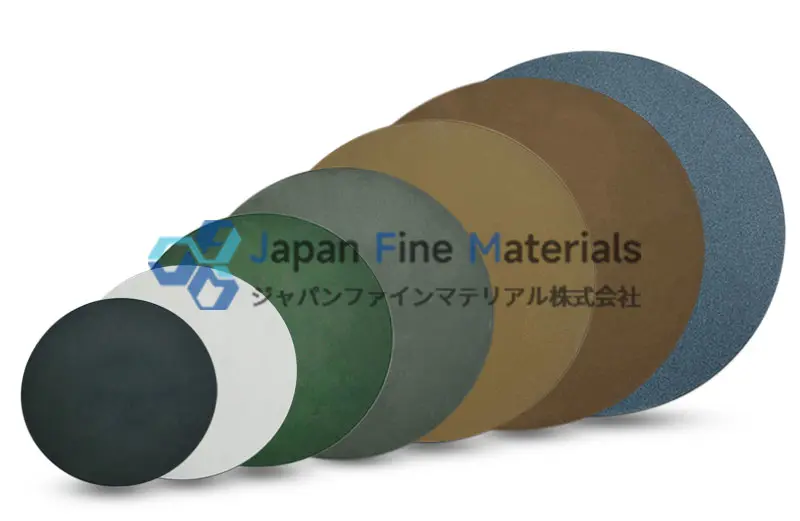
Definition of Porous Ceramics
Porous ceramics consist of a solid skeleton phase and a gaseous pore phase. The skeleton is typically formed from high-quality raw materials such as Alumina (Aluminum Oxide), Silicon Carbide, or Cordierite, which determine the material's mechanical strength, thermal stability, and chemical inertness. Meanwhile, the pores form a complex three-dimensional interconnected network, providing functional characteristics such as permeation, adsorption, and diffusion.
From a microscopic perspective, porous ceramics are heterogeneous and anisotropic systems. The shape, distribution, and thickness of the pores directly affect the material's overall performance. For example, higher pore interconnectivity improves gas permeability, but excessive connectivity may lead to a decrease in mechanical strength. Conversely, closed-pore structures contribute to improved thermal insulation and the mitigation of thermal shock.
Furthermore, at the interface between the skeleton and pores of porous ceramics, micro-scale roughness and thin-film effects on the pore walls often exist, playing a crucial role in gas molecule diffusion, liquid penetration, and surface adsorption properties. With pore sizes ranging from nanometers to millimeters, these materials offer high controllability for applications in adsorption, filtration, and thermal management.
Pore scales are typically classified as follows:
● Micropores (< 2 nm): Featuring a high specific surface area, used for molecular sieves, gas adsorption, or catalyst supports.
● Mesopores (2–50 nm): Frequently used for catalyst supports, therapy/diagnostics, adsorbents, and drug delivery systems.
● Macropores (> 50 nm): Suitable for filters (e.g., molten metal filters), biological scaffolds, membrane separation, and high-temperature insulation.
In engineering design, different pore size structures are often used in combination to achieve a balance between high filtration efficiency and structural strength.
Control and Engineering Design
The design of the pore structure is the core factor determining the performance of porous ceramics. There are three key indicators:
1. Pore Size Distribution
The uniformity of pore size directly affects filtration precision, fluid resistance, and specific surface area. Pore size can be stably controlled through the selection of forming methods, sintering processes, and atmospheric control.
2. Porosity
Porosity determines the balance between permeability and structural strength. In semiconductor and high-precision manufacturing fields, proper porosity design is vital for vacuum adsorption performance and overall reliability.
3. Pore Interconnectivity
A highly interconnected pore structure increases the passage rate of fluids and gases, but excessive connectivity reduces mechanical support capacity. Since pore interconnectivity also affects the uniformity of thermal expansion and stress distribution, it is an essential factor to consider when designing wafer handling systems.
Material Systems of Porous Ceramics
The performance of porous ceramics is heavily dependent on the matrix (base) material. Below are the common material systems used at JFM:
| Material System | Key Characteristics | Typical Applications |
|---|---|---|
| Alumina (Al₂O₃) | High strength, wear resistance, and excellent electrical insulation | High-temp filters, electronic insulators, structural supports |
| Zirconia (ZrO₂) | High toughness, low thermal conductivity, high heat resistance | Wafer handling, vacuum chucks, mechanical supports |
| Silicon Carbide (SiC) | High thermal conductivity, thermal shock & corrosion resistance | High-temp filters, combustion systems, gas distribution |
| Silicon Nitride (Si₃N₄) | High toughness, thermal shock resistance, wear resistance | Supports for temp fluctuations, bearings, and precision filters |
| Composite Materials (e.g., SiC–ZrO₂) |
Balances strength and stability | Multifunctional components for semiconductor equipment |
Currently, JFM is capable of manufacturing porous ceramics from Alumina and Silicon Carbide materials.
Manufacturing Processes for Porous Ceramics
The manufacturing process of porous ceramics directly dictates the microscopic pore structure and final properties. Currently, mainstream forming methods are classified into the following five categories:
1. Pore Former Method: Organic or inorganic agents burn off during sintering, leaving behind uniform pores.
2. Foaming Method: Bubbles are generated in the slurry to create foam-like, low-density bodies.
3. Freeze Drying Method: Solidification and subsequent freeze-drying maintain an oriented pore channel structure.
4. Sol-Gel Method: Deposition of colloidal particles during gelation creates nanometer-scale pores.
5. Extrusion Molding Method: Ceramic slurry is forced through a die to mold continuous, regular channels.
Performance Characteristics and Physical Mechanisms
1. Thermal Properties: Lower thermal conductivity than dense ceramics, providing excellent insulation.
2. Mechanical Properties: Optimized skeleton connectivity ensures high strength even with high porosity.
3. Permeation and Filtration: Interconnected pores equalize flow velocity and reduce pressure loss.
4. Chemical Stability: High resistance to acids and alkalis ensures stability in corrosive environments.
5. Electrical Insulation: Resistant to cracking under temperature changes, ideal for vacuum systems.
6. Adsorption and Catalysis: A High specific surface area enables functional roles in reactions.
Applications of Porous Ceramics
1. Filtration: Efficient capture of particles in molten metals and exhaust gases.
2. Energy: Used as a catalyst support in fuel cells and automotive converters.
3. Biomedical: Acts as a scaffold for bone replacement and drug delivery.
4. Thermal Protection: Used in furnace linings to improve equipment longevity.
Semiconductor and Advanced Process Areas
1. Porous Ceramic Vacuum Chucks
● Applicable Processes: Lithography, back grinding, wafer inspection.
● Role: Provides uniform vacuum adsorption without leaving marks, ensuring wafer flatness.
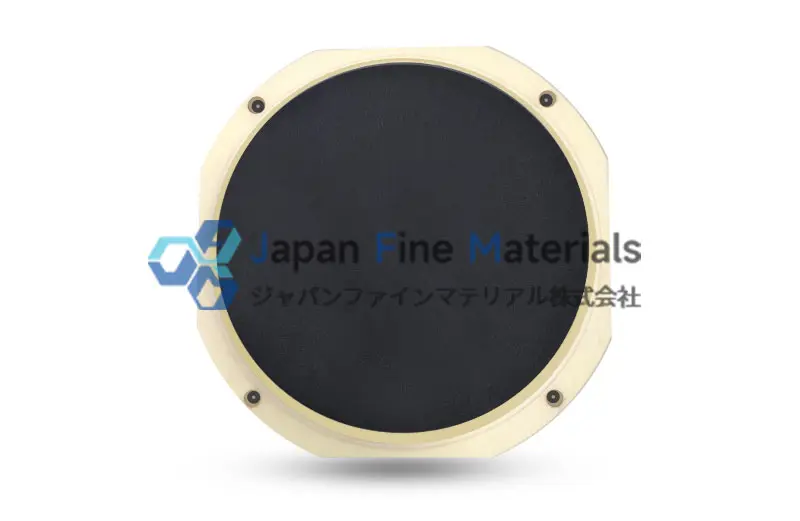
2. Porous Media Layer for ESC
● Role: Distributes helium gas to control wafer backside temperature uniformity.
3. Gas Diffuser / Showerhead
● Role: Ensures uniform supply of process gases in etching and deposition chambers.
4. In-Line Gas Filters
● Role: Filters high-purity gases under challenging conditions.
Conclusion
If you are looking for high-performance porous ceramic solutions, please feel free to contact JFM. JFM focuses on the R&D and custom manufacturing of advanced ceramics, providing reliable solutions for semiconductor systems.
JFM—Making every detail more stable and cleaner.
FAQ
Q1: Difference between porous and dense ceramics?
Porous ceramics emphasize pore controllability for permeability, a feature that dense ceramics lack.
Q2: Can pore size be customized?
Yes, from nanoscale to millimeter scale through process adjustment.
Q3: Benefits for semiconductor manufacturing?
Low particle generation, uniform adsorption, and thermal stability.
Q4: Can they filter liquids?
Yes, they offer superior durability in corrosive liquid environments.
Q5: What is the lifespan?
Significantly longer than metal or polymer parts, reducing total costs.